Artwork code ART-0002
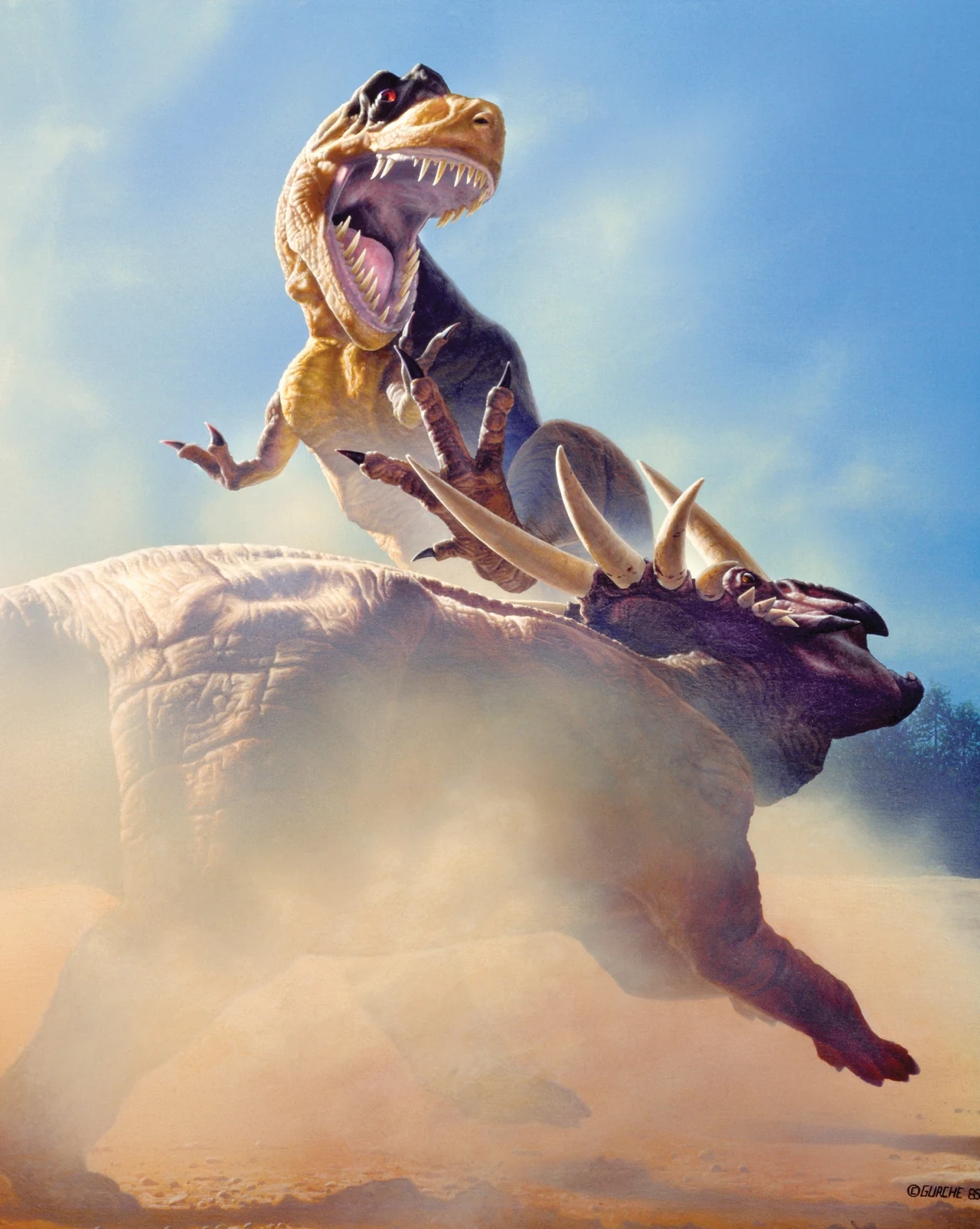
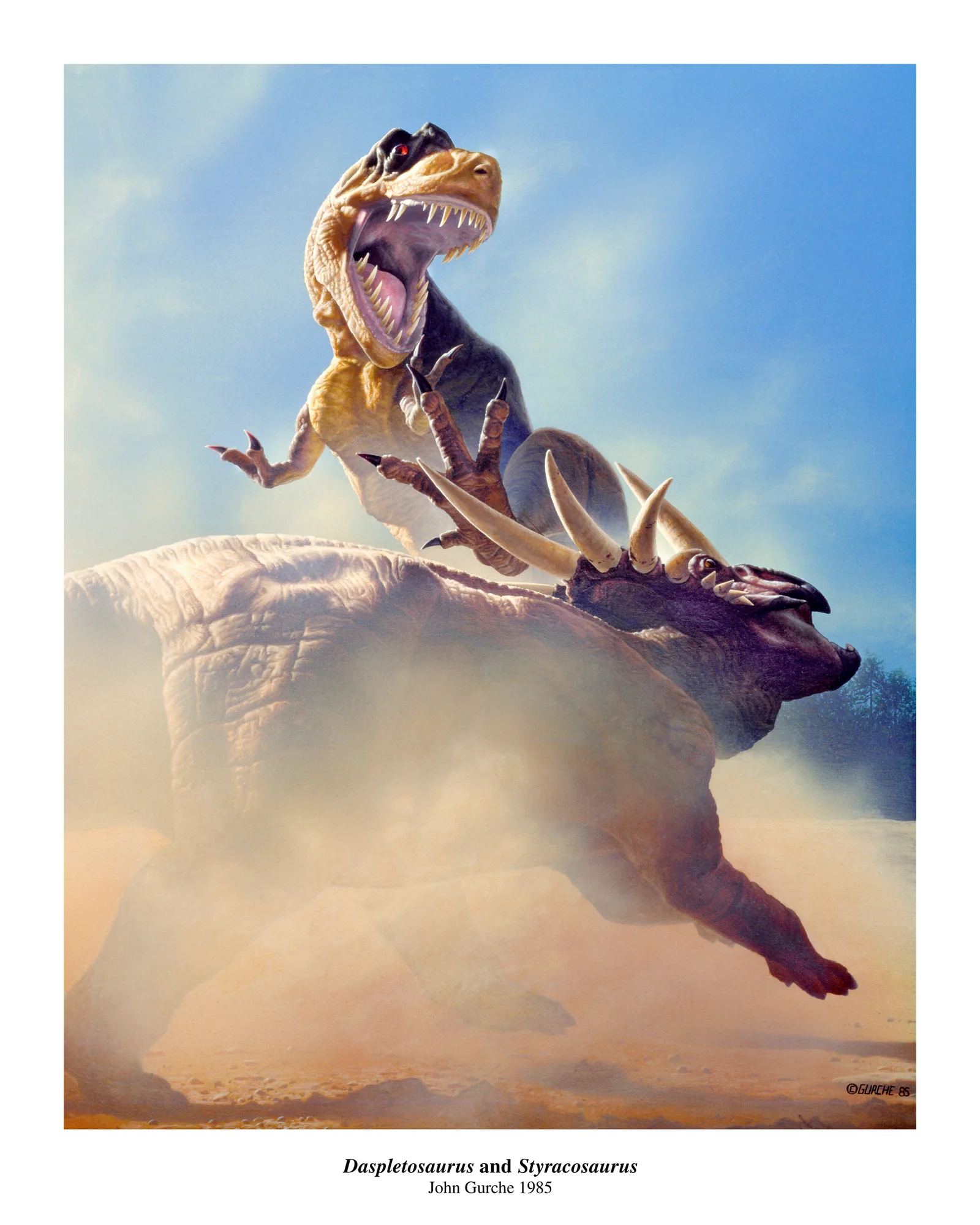
Daspletosaurus and Styracosaurus
The print
Cover art for Robert Bakker's The Dinosaur Heresies (William Morrow, 1986).
Painted 1985
- Available sizes
Read John's accountof Daspletosaurus and Styracosaurus“I felt this would be like standing next to two locomotives colliding. I had to get that energy into the painting.”
It all started when Yale paleontologist John Ostrom made a discovery in the late 1960s that did not fit the prevailing view of dinosaurs as slow, stupid, solitary, cold-blooded animals. This was the American Velociraptor, later to star in the movie Jurassic Park. This creature hunted with an enlarged toe claw, implying a very active lifestyle. Not only that, but they seemed to have been social, hunting in packs. The ball began to roll.
The early 1980s was a very exciting time to be working as a paleoartist depicting dinosaurs. Radical new ideas about how dinosaurs lived were being debated among scientists, but had yet to reach the public. When these new ideas were finally presented to the public, I was fortunate to be part of that effort, depicting dinosaurs as active, intelligent, social creatures.
Fast-forward to 1985. I received a call from William Morrow Books, who told me that a student of Ostrom's, Bob Bakker, was coming out with a book on the new dynamic dinosaurs. Would I be interested in doing a painting for the cover? I had painted dinosaurs for the Smithsonian, but they had been the old tail-dragging kind. I was excited about this new challenge.
I wanted to create a painting that depicted high activity levels. What if we were to stand right next to a conflict between a horned dinosaur and a tyrannosaur? With the cranked-up activity levels hypothesized in the book, I felt this would be like standing next to two locomotives colliding. I had to get that energy into the painting. I began to see a great deal of dust being kicked up. Both dinosaurs could be depicted in unsustainable poses, emphasizing that you are seeing one frame in a very active scene.
I also wanted to emphasize the dinosaur–bird connection discussed in the book. I chose a bird-like pose for the tyrannosaur (called Daspletosaurus), defending itself from a lunge by the horned dinosaur (called Styracosaurus) with its foot. This would also suggest a high activity level by presenting an unstable pose that had to be part of an action sequence. For coloring in the Daspletosaurus, I chose a bird-like model — that of a black-capped chickadee.
The Dinosaur Heresies was a blockbuster. It began a huge uptick in public interest in dinosaurs. I was later told by someone at Amblin Entertainment that The Dinosaur Heresies cover painting was the reason why Steven Spielberg brought me on board to work on the movie Jurassic Park. In storyboard drawings for the movie, and in the first Tyrannosaurus scene, the creature is seen doing a lot with its feet.
Samples
These prints are offered to museums, institutions, and collectors. Please get in touch to discuss availability and terms.